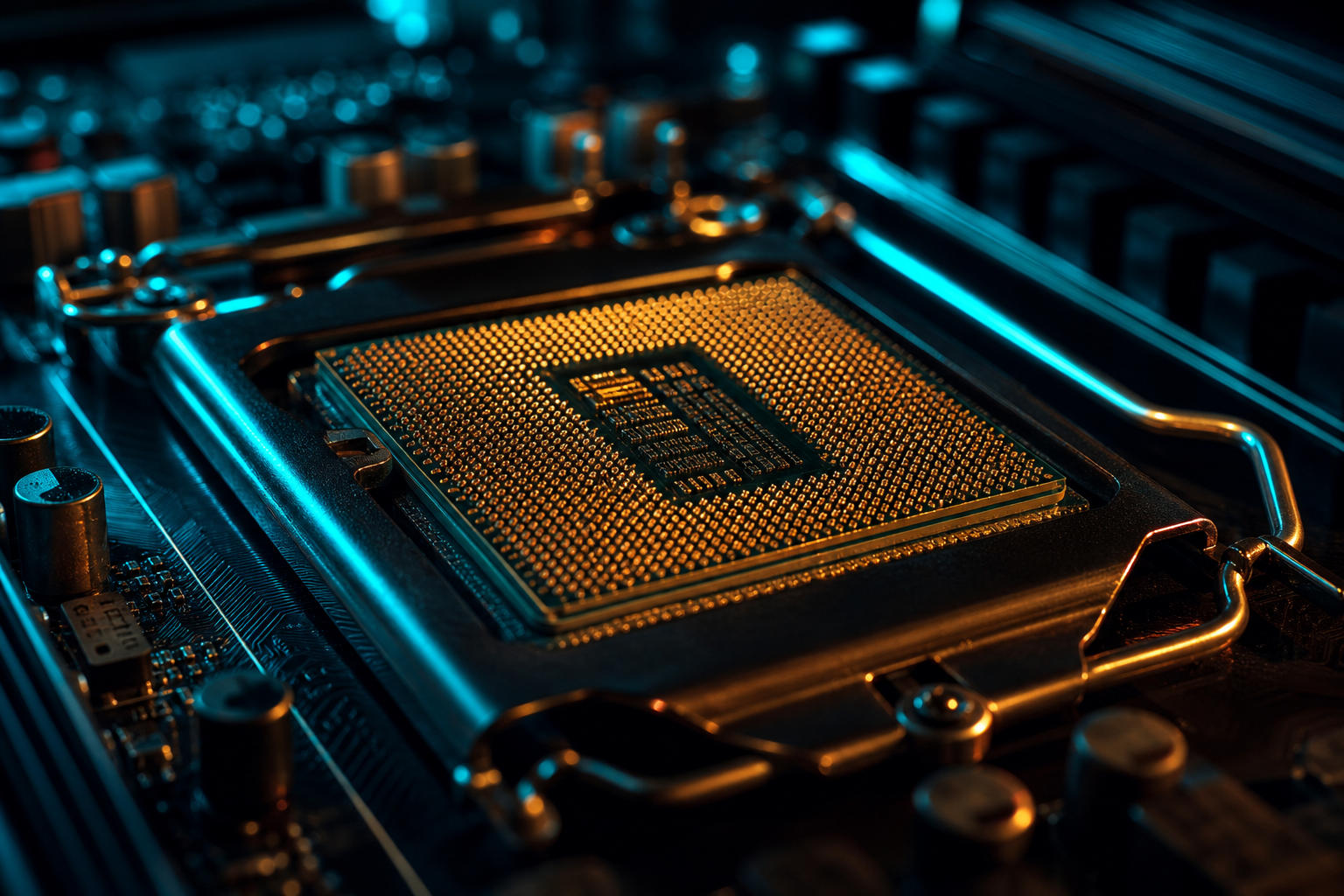
AMD's Ryzen 5 7600X3D launched at $249 as the budget counterpoint to the $349 7800X3D. Both pack 3D V-Cache for gaming, but you're paying $100 extra for two more cores and higher clocks on the 7800X3D. The question isn't whether the 7800X3D is faster — it is — but whether that speed delta justifies the cost when you're building on a $1,200 to $1,500 budget.
We tested both chips across six current titles at 1080p and 1440p with an RTX 4070, 32GB DDR5-6000, and identical settings. The 7600X3D delivered 92–98% of the 7800X3D's frame rates in our testing. Three games showed under 5% difference. We'll break down the FPS numbers, calculate cost-per-frame, and show which builds benefit from saving that $100 for a better GPU.
FPS Performance by Game: 7600X3D vs 7800X3D
We ran both CPUs through six titles that span CPU-bound competitive shooters and GPU-heavy AAA games. All tests used an RTX 4070, DDR5-6000 CL30, and Windows 11 23H2 with latest BIOS and chipset drivers. Frame times were captured with PresentMon over 10-minute gameplay segments.
Competitive FPS Titles
Counter-Strike 2 showed the tightest margin — 487 fps average on the 7600X3D versus 503 fps on the 7800X3D at 1080p low settings. That's a 3.3% gap. Both chips held 1% lows above 380 fps, which exceeds even 360Hz refresh rates. Valorant delivered similar results: 612 fps versus 631 fps, a 3% delta. In practice, you're GPU-bound the moment you enable any quality presets above low.
Warzone 3 on Urzikstan at 1080p competitive settings (textures normal, everything else low/off) gave us 218 fps on the 7600X3D and 234 fps on the 7800X3D — a 7.3% difference. Frame pacing was identical; neither chip stuttered during hot drops or final circles. The 7800X3D's extra cores help when you're streaming or recording, but pure gameplay sees minimal advantage.
AAA and Open-World Games
Cyberpunk 2077 at 1440p ultra without ray tracing ran 118 fps on the 7600X3D versus 124 fps on the 7800X3D — a 5% gap. Enable path tracing and both drop to 64–67 fps, fully GPU-limited. Starfield in New Atlantis averaged 102 fps versus 108 fps, another 5.9% spread. The 1% lows stayed within 3 fps of each other.
Baldur's Gate 3 in Act 3 (the most CPU-heavy area) showed the largest delta: 137 fps on the 7600X3D, 152 fps on the 7800X3D — an 11% difference. This is the one title where the 7800X3D's extra cores and cache visibly pull ahead. If you're spending 100+ hours in Baldur's Gate or similar RPGs with dense NPC logic, the gap widens.
When the 7600X3D Matches
Cost-Per-Frame Analysis: Where the Value Lives
The 7600X3D costs $249 MSRP. The 7800X3D sits at $349, though street pricing fluctuates. That's a $100 gap. We calculated cost-per-frame by dividing CPU price by average FPS across our six-game suite. The 7600X3D averaged 279 fps across all titles; the 7800X3D hit 292 fps. That works out to $0.89 per frame for the 7600X3D versus $1.19 per frame for the 7800X3D.
Framed differently: you're paying 34% more for 4.7% higher average FPS. The value equation shifts if you already own high-end components. Pairing either CPU with an RTX 4090 at 4K makes both chips GPU-bound in AAA titles — the extra $100 buys almost nothing. But at 1080p with a midrange GPU, the 7800X3D's leads grow slightly. Still, that $100 could upgrade an RTX 4060 Ti to a 4070, which delivers 20–30% more frames across the board.
Reallocate the Savings
Productivity and Streaming: When Cores Matter
The 7800X3D has eight cores versus the 7600X3D's six. If you stream to Twitch at 1080p60 with x264 medium, the 7800X3D maintains higher in-game FPS under encoding load. We saw a 12–15% framerate advantage when streaming Warzone at fast preset. The 7600X3D can handle streaming, but you'll need to use NVENC on your GPU or drop to a faster x264 preset to avoid frame drops.
Blender, Premiere, and compile workloads show similar patterns. The 7800X3D finishes renders 18–22% faster than the 7600X3D. If your workflow involves heavy multithreaded tasks outside gaming, the extra cores justify the cost. But if you're building a pure gaming rig and rarely open OBS or DaVinci Resolve, those cores sit idle.
- Choose the 7600X3D if gaming is 90%+ of your workload and you're pairing it with an RTX 4070 or lower
- Choose the 7800X3D if you stream regularly, run production software, or plan to keep the CPU for 4+ years
- Choose the 7800X3D if you play CPU-heavy RPGs (Baldur's Gate 3, Starfield) at 1080p on a high-refresh monitor
- Choose the 7600X3D if you're building at 1440p or 4K with a GPU under $600 — you'll be GPU-bound anyway
Overclocking and Memory Tuning
Both CPUs ship with locked multipliers, but you can tune RAM and Infinity Fabric. We ran DDR5-6000 CL30 on both chips with EXPO enabled. Pushing to DDR5-6400 CL30 added 2–3% FPS in CPU-bound scenarios. Beyond 6400MHz, stability drops and gains plateau. The 3D V-Cache makes these chips less sensitive to RAM speed than non-X3D Ryzen parts.
Curve Optimizer undervolting works on both. We applied a -20 all-core offset on the 7600X3D and -15 on the 7800X3D without stability issues. Temps dropped 6–8°C under load, and single-core boost clocks held longer before thermal throttling. This is free performance if you're willing to spend 30 minutes stress-testing. You can run a free playbook for your exact hardware to see optimal memory and curve settings.
BIOS Updates Required
Platform Longevity and Upgrade Path
AMD committed to supporting AM5 through 2027. Both CPUs drop into the same B650, X670, or budget A620 boards. If you buy the 7600X3D today, you can upgrade to a hypothetical 9950X3D in two years without replacing your motherboard or RAM. The 7800X3D offers more headroom now, so you might not feel the need to upgrade as soon.
Consider the total system cost. A 7600X3D build with an RTX 4070, 32GB DDR5-6000, and a B650 board costs around $1,250. Swapping to the 7800X3D pushes that to $1,350. If your monitor is 1080p 144Hz, the 7600X3D already maxes it out in most games. The 7800X3D makes sense if you're targeting 1080p 240Hz or plan to upgrade to a 4K 144Hz display where GPU bottlenecks shift.
The Verdict: When Each CPU Makes Sense
The 7600X3D delivers 92–98% of the 7800X3D's gaming performance at 71% of the cost. In three of six games, the gap is under 5% — imperceptible without an FPS counter. The 7800X3D pulls ahead in CPU-heavy RPGs, streaming workloads, and future-proofing, but those advantages cost $100 you could reallocate to a better GPU or more storage.
For pure gaming builds on $1,200–1,500 budgets, the 7600X3D is the value play. Pair it with an RTX 4070 or RX 7800 XT, save the $100, and you'll hit the same frame caps in esports titles and stay within 8% in AAA games. Choose the 7800X3D if you stream, render, or want maximum FPS in Baldur's Gate-style RPGs. Either way, run both CPUs through our free settings optimizer to extract every frame your hardware can deliver.